This discussion draws on over 25 pages of original records and hand-drawn sketches documenting by-products equipment at the Interlake Chicago Coke Plant between 1952 and 1957. The materials include teletype requests and pink carbon memos, field reports from Wilputte Coke Oven Division, correspondence with Roots-Connersville Blower Corporation, and detailed operational data tables. Together, these documents offer a rare, granular look at how the plant’s pioneering gas cooling systems were monitored, troubleshot, and adapted over time. For those interested in exploring the complete file, the full PDF can be downloaded below.
Laura Kessler:
I noticed there were several reports about the primary gas coolers and the liquor coolers. Why were there so many adjustments and observations in such a short time?
Frank Malloy:
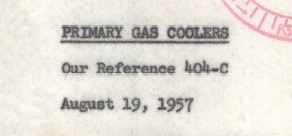
That was because Interlake was running the first installation of spray-type primary gas coolers in any coke plant. You can see in the August 7, 1957 Wilputte letter where they say plainly:
“It is to be noted that this is our first installation of this kind and in all probability the first installation in the coke oven industry.”
So naturally, they were measuring everything—temperatures in, temperatures out, pressures, liquor flow—to see if it really worked in practice.
Martin Zajac:
And you have to remember the sheer volume: 24 million cubic feet per day of coke oven gas. Even small temperature swings could mean tons of naphthalene dropping out or staying vaporized. That’s why they kept checking if operating one cooler instead of two was better, especially in hot weather.
L.K.:
Why was there so much concern over naphthalene?
F.M.:
Because if it condensed in the gas lines, it would literally clog them solid. There’s a note in the October 21, 1957 report:
“Mr. Chamberlain…recently found the suction main to exhauster one-half filled with naphthalene.”
That’s a nightmare—imagine trying to heat or scrape it out.
M.Z.:
Exactly. That’s why they were trying to run the outlet gas temp above the dew point—around 38°C—so naphthalene would stay vaporized till the final cooler.
L.K.:
Some of the correspondence goes to Cleveland and some to Chicago. How was Interlake organized?
F.M.:
Good catch. The coke plant was in Chicago, but Cleveland was effectively the headquarters. They called the shots and provided engineering guidance.
M.Z.:
It was common—big steel companies operated like that. Your observation is spot on: Interlake Cleveland issued instructions or approvals, Chicago executed. And if you look at that 1957 memo to J.B. Hasle in Cleveland, it shows how headquarters still reviewed operational issues in detail.
L.K.:
I saw mention of the liquor sprays increasing from 75 to 175 per battery. Was that a big deal?
F.M.:
Yes, huge. More sprays meant more flushing liquor to scrub tar and ammonia from the hot gas. But it also meant the old pumps couldn’t keep up—hence the 3,000 GPM pump upgrades in 1979.
M.Z.:
I’d call it almost a doubling of the spray rate per battery—when you see that in a plant, you know the system’s capacity is being pushed hard.
L.K.:
What was the syphon system for handling naphthalene from sump to gas mains?
F.M.:
That’s the little hand-drawn sketch dated April 2, 1956. They used a Schutte & Koerting steam jet pump to lift condensed naphthalene from the sump up into the suction main—about 24 feet of vertical lift.
M.Z.:
Steam jets were common for handling sticky condensates—fewer moving parts to gum up. I have to say, I love that you’ve saved these hand-drawn prints. Those were made by people who expected them to get dirty and used.
L.K.:
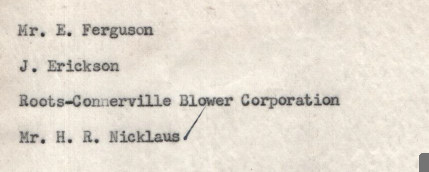
The Roots-Connersville letter mentioned a 1913 exhauster shaft. Were they really still using that 40 years later?
M.Z.:
Oh, easily. Coke plants often ran machinery for decades. But here, the vendor flat-out refused to try metal spraying to refurbish it. They knew it was time for a new shaft.
F.M.:
I’ll say—if you have to rebore and resleeve everything, you’re throwing good money after bad.
L.K.:
Why do the reports sometimes say “South Chicago” when the plant was actually in South Deering?
F.M.:
Kind of an informal shorthand. “South Chicago” was probably used internally to distinguish from other works. Like “South Works” at US Steel, even though that wasn’t an official neighborhood name.
M.Z.:
Right—people in the mills often used their own naming conventions that ignored the city’s 77 community areas. I have to admit, your notes about that fascinated me.
L.K.:
Do you both think this level of record-keeping was common?
F.M.:
It was, in big integrated producers. Especially when installing first-of-kind equipment.
M.Z.:
And your sidebars about recovering these documents decades later—I find that incredible. You’re basically reconstructing plant operations from the inside out. I’ve worked in places that threw everything out the day they shut the gates.
L.K.:
Any final thoughts on all this?
M.Z.:
I’m just struck by how the everyday technical challenges—like summer water temps being too high, or a tar pump oiling itself to death—are what really determined success. Big capital plans look grand on paper, but it’s the thousand details in these memos that kept the plant running.
F.M.:
Amen to that.